Joe Green Intervenes in the Brick-Field Horse Abuse
Black BeautyJoe Green’s intervention at the brick-field marks a turning point in his growth from a careful, inexperienced stable boy into someone prepared to oppose cruelty openly. When a carter continues whipping two horses trapped with a heavy load, Joe does not ride past or treat the abuse as somebody else’s concern: he seeks help, offers evidence, and earns John Manly’s approval. The episode makes intervention—not merely private kindness—the practical test of concern for animals.
Setting and Background
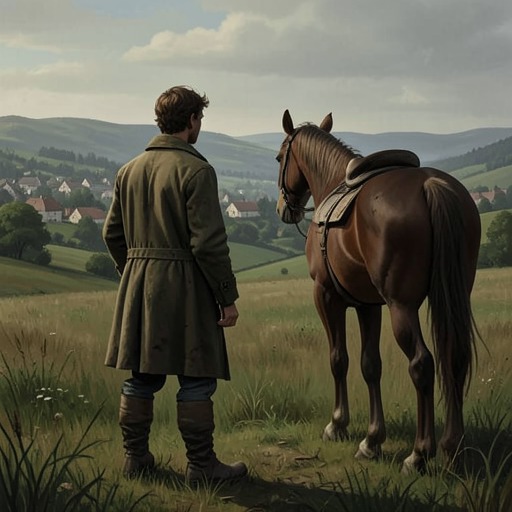
Joe is entrusted with the errand because Squire Gordon needs a note delivered promptly to a gentleman about three miles away. John Manly is away with Justice in the luggage cart, and the master tells Joe to saddle Black Beauty and ride steadily. Joe has learned quickly and is attentive, but his small size means that he is seldom allowed to exercise either Black Beauty or Ginger. The errand therefore gives him an uncommon responsibility, which becomes more consequential when the return journey brings him to the brick-field.
The setting is part of a household and community in which humane treatment is already an expressed principle. Black Beauty recalls that Squire Gordon and his wife were respected for kindness to people and animals, and that their servants followed their example. If village children were known to mistreat a creature, they heard about it from the Hall. Squire Gordon and Farmer Grey had also worked for more than twenty years to end the use of check-reins on cart-horses; in their district, such reins had become uncommon. That background does not prevent cruelty at the brick-field, but it establishes the moral expectation against which Joe’s response is measured.
The Encounter at the Brick-Field
The note is delivered, and Joe and Black Beauty are returning quietly when they see a cart heavily loaded with bricks. Its wheels are stuck fast in deep ruts filled with stiff mud. The two horses are straining to pull the cart free, but cannot move it. The carter shouts and lashes them, while also pulling fiercely at the fore horse’s head. The immediate cause of the horses’ inability to move is plain to Joe: the wheels are too firmly stuck, and more force will not free the load.
Joe first calls on the carter to stop whipping the horses and points out that the cart cannot move while its wheels remain trapped. When the man pays no attention, Joe makes a second appeal: he offers to help lighten the cart. The carter refuses his assistance and tells him to mind his own business. He is in a towering temper and has been drinking, and he resumes using the whip. Joe’s attempt to address the problem directly has failed; the abuse continues, and the carter rejects the practical solution that might have relieved the horses’ effort.
Rather than remain there to argue, Joe turns Black Beauty around and rides at a brisk gallop to the house of Mr. Clay, the master brick-maker. Black Beauty notes that John might not have approved of their pace, but that he and Joe were of one mind and too angry to go more slowly. Joe knocks and calls for Mr. Clay, then explains that a man in the brick-yard is whipping two horses and would not stop when asked. His voice shakes with excitement. The urgency of the appeal carries the account beyond a private confrontation and brings someone with authority over the yard to the scene.
Reporting and Testimony
Mr. Clay responds at once, running in to get his hat. Before leaving, he asks whether Joe will give evidence if the carter is brought before a magistrate. Joe agrees. That offer matters: he is not only asking an adult to intervene in the immediate abuse but also accepting responsibility for describing what he witnessed if the matter proceeds formally. He and Black Beauty then return home at a smart trot.
John Manly notices that Joe is visibly angry as he dismounts. Joe recounts what happened, and John commends him for acting even if the carter receives no summons. In John’s view, many people would have ridden by and said that interference was not their business; he instead affirms that cruelty and oppression make intervention everybody’s business. The exchange links Joe’s choice to the teaching and example he has received, while also giving it a wider ethical force: witnessing harm creates an obligation to respond when one can.
The matter quickly advances from report to testimony. As Joe and John are about to go to dinner, a footman comes to the stable to say Joe is wanted in Squire Gordon’s private room. A man has been brought up for ill-using horses, and Joe’s evidence is required. Squire Gordon is one of the county magistrates, so cases are often brought to him for settlement or directions about what should happen. Joe straightens his clothes and goes in, eager to give his account. His testimony is reported to have been clear. The horses’ exhausted condition and the marks of their rough treatment also form part of the case; the carter is committed to take his trial and might receive a prison sentence of two or three months. The narrative does not say what sentence is ultimately imposed.
Joe’s Development and the Episode’s Meaning
The incident changes how Joe carries himself. Once back in the stable, he is in high spirits and gives Black Beauty a good-natured slap, saying that they will not see such things done. He cleans the horse’s feet and rubs him down with a firmer hand than usual. John observes that Joe seems to have grown an inch taller in a week. The narrator treats this as a measure of moral enlargement rather than a literal transformation: Joe remains kind and gentle, but now acts with greater purpose and determination, as if he has moved abruptly from boyhood toward manhood.
The scene also extends a lesson voiced elsewhere in the book. In James Howard’s recollection of school, a boy who had tormented flies was punished, and the schoolmaster taught that cruelty toward the weak was cowardly and hard-hearted. John Manly later insists that religion without kindness to people and animals is a sham. Joe’s actions put those principles into practice: he recognizes the horses’ distress, tries to stop the immediate harm, finds a person able to act, and agrees to help establish what happened. Similarly, Jerry Barker later argues that people who can expose wrongdoing but choose not to do so become sharers in its guilt. These episodes frame intervention as a recurring responsibility, not an exceptional act reserved for those already in authority.
The brick-field episode does not claim that Joe alone can remedy the conditions behind every instance of animal abuse, nor does it report the carter’s final punishment. Its narrower achievement is concrete: a witness refuses indifference, turns a failed plea into a report, and follows through with evidence. In the story’s moral world, that sequence is what allows sympathy to become action—and gives Joe a more deliberate role among the people charged with protecting the horses in their care.